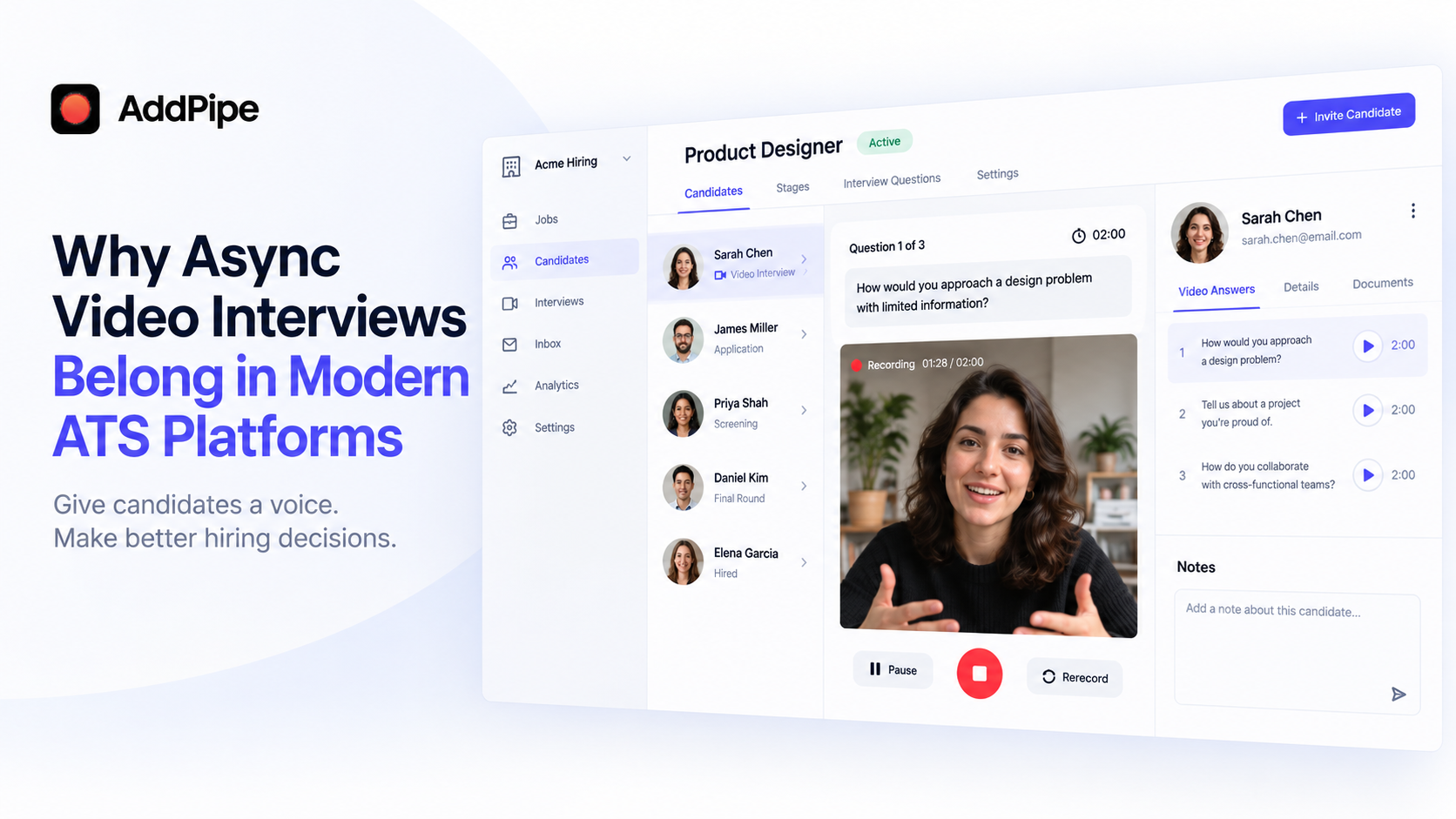
Why Async Video Interviews Belong in Modern ATS Platforms.
A resume tells you what a candidate has done. But what if your recruitment platform could let them demonstrate it?
Imagine reviewing applications for a customer-facing position.
Dozens of candidates have relevant experience. Their resumes look promising, but you'd like to understand how they explain problems, communicate with customers, or approach real-world scenarios.
Traditionally, that means scheduling introductory interviews.
But there's another option.
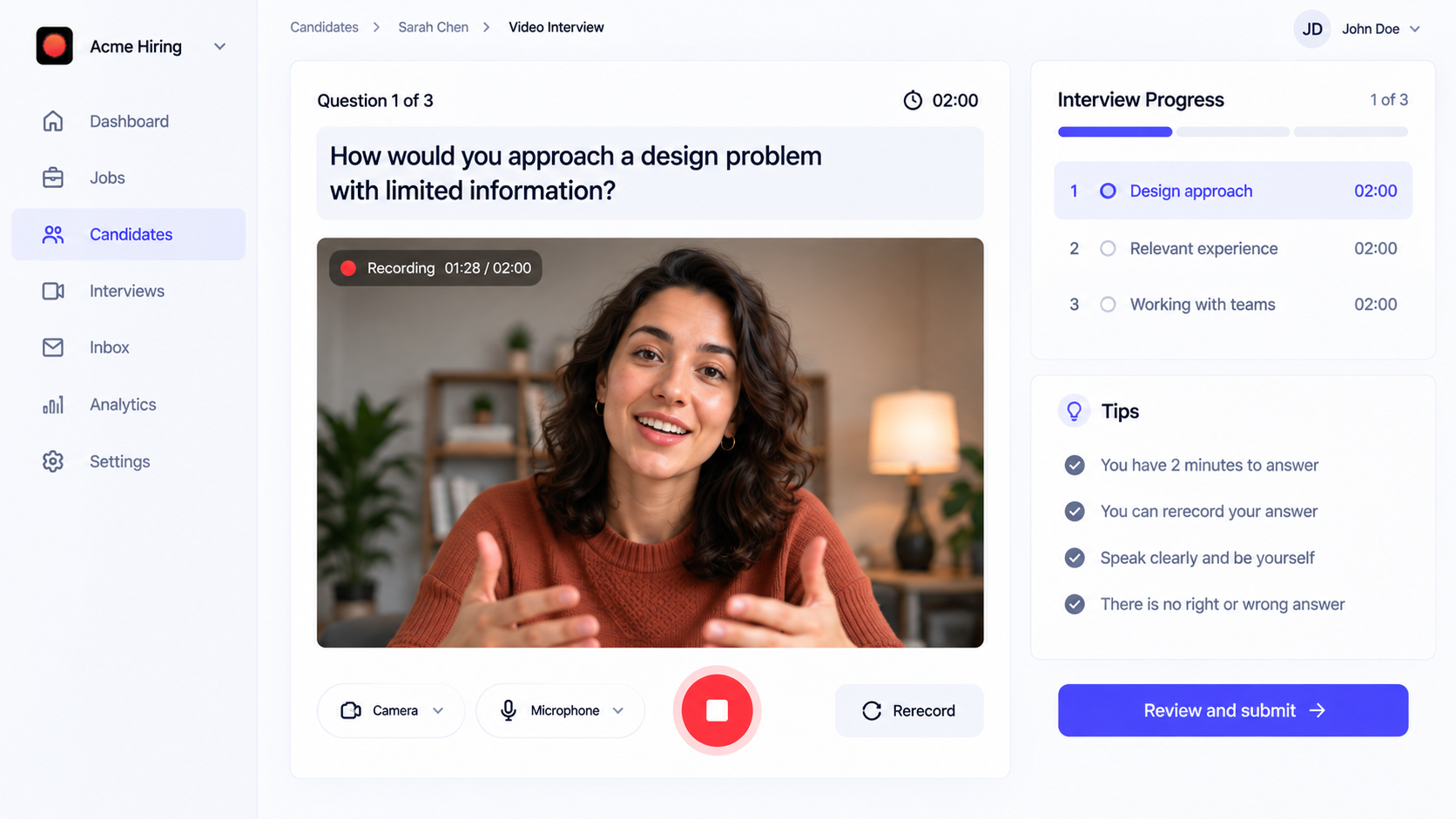
Async video interviews let candidates record answers to predefined questions, while recruiters review those responses whenever convenient.
And it's a capability that established recruitment platforms already offer.
For HRTech companies building applicant tracking systems (ATS), job boards, and recruitment applications, this creates a product opportunity worth exploring.
What are async video interviews?
Asynchronous video interviews, also called one-way video interviews, allow candidates to answer interview questions through recorded video rather than participating in a live conversation.
A typical process looks like this:
Application → Interview invitation → Recorded answers → Recruiter review → Next hiring stage.
Candidates can complete their recordings when convenient.
Recruiters can review responses without coordinating a live meeting.
This format can be particularly useful when organizations want to collect structured, job-relevant responses from candidates across different schedules or time zones.
It doesn't need to replace traditional interviews.
Instead, it can provide an additional screening option between an initial application and a live conversation.
How established recruitment platforms use async video interviews.
Async video interviewing is already part of established recruitment technology.
Workable: Video interviews inside the ATS.
Workable allows hiring teams to add one-way video interviews to specific stages of their recruitment pipelines.
Employers can configure interview questions, preparation time, answer duration, and the number of recording attempts.
Candidates submit recorded responses that become available for review within the hiring workflow.
Workable also allows candidates to practice before recording.
Spark Hire: A dedicated interviewing solution.
Spark Hire offers one-way video interviews with predefined questions, recording controls, and recruiter evaluation tools.
Its platform supports recruitment teams that want to review candidates without scheduling an initial live conversation.
These examples illustrate an important product decision.
Recruitment platforms can offer async interviewing as a native feature or integrate with specialized interviewing software.
For smaller HRTech companies, the right approach depends on how much control they want over the experience.
And a recruitment SaaS doesn't necessarily need to reproduce every capability of an enterprise interviewing platform.
It could start with something simpler: allowing candidates to record answers directly within an existing application workflow.
Where async video interviews add value.
A recorded response isn't necessary for every job application.
But for some roles, spoken answers can provide information that is difficult to capture in a resume.
Consider these examples.
Customer support.
A candidate explains how they would handle a frustrated customer.
Sales.
An applicant delivers a short product introduction or responds to a sales objection.
Language-dependent positions.
Candidates demonstrate spoken communication in a language relevant to the role.
Remote recruitment.
Applicants and hiring teams participate across time zones without coordinating an initial live call.
These are potential applications, not evidence that video interviews improve hiring decisions in every situation.
The value comes from asking relevant questions and designing a fair, useful screening experience.
For recruitment software developers, this flexibility can become another capability their platform offers.
The candidate experience matters more than you might think.
Adding a recording feature is only part of creating a successful async interview experience.
A study published in Human Resource Management examined asynchronous video interviews involving 27,809 applicants across 33 companies in 11 countries.
The researchers found that more preparation time and opportunities to rerecord answers were associated with more favorable applicant reactions.
Including more questions was associated with less favorable reactions.
For HRTech product teams, the implications are practical.
Candidates should understand what's expected, have a straightforward way to record their responses, and receive enough preparation time.
Where appropriate, allowing users to review and rerecord their answers can provide greater flexibility.
Accessibility, privacy, and transparency should also be considered throughout the experience.
The objective shouldn't be to collect as many video responses as possible. It should be to make relevant candidate responses easy to submit and review.
How can ATS developers add async video interviews?
Here's where the product opportunity becomes particularly interesting.
Imagine an ATS developer wants to introduce an asynchronous interview stage.
The application already manages candidates, vacancies, invitations, and hiring pipelines.
Now it needs to collect recorded answers.
That introduces several technical requirements.
The platform must capture video in the browser, process recordings, associate responses with candidate applications, and make completed recordings available for review.
But does the development team also need to build and maintain the recording infrastructure?
Not necessarily.
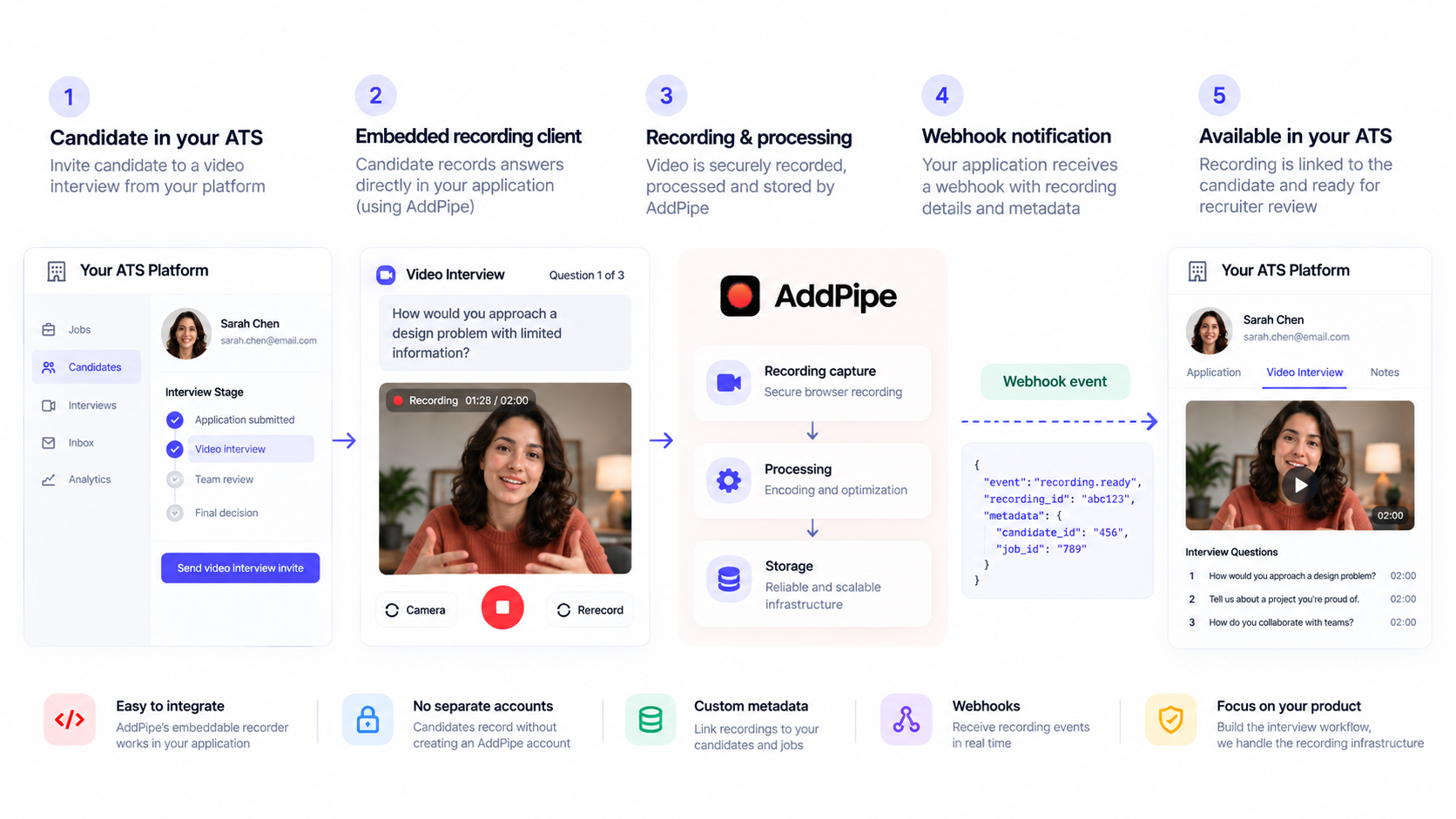
Build the interview experience, not the recording infrastructure.
AddPipe provides an embeddable video recorder that developers can integrate into their own websites and applications.
Candidates can record directly within the recruitment platform, without installing separate recording software or creating an AddPipe account.
The Pipe Recording Client supports video playback and rerecording.
Meanwhile, the Pipe Platform infrastructure handles recording, processing, and storage.
Developers can also connect recorded answers to their existing application workflows.
For example, an ATS can use custom recording metadata to associate a video response with an internal candidate application identifier.
When a recording-related event occurs, AddPipe webhooks can deliver the recording information and associated metadata to the application.
The ATS can then update its records and make the processed recording available for recruiter review once the appropriate processing and storage events have completed.
Importantly, AddPipe provides the recording technology, not a complete recruitment management system.
The HRTech application remains responsible for candidate authentication, interview questions, recruiter permissions, and appropriate data handling.
This separation allows developers to focus on the experience that differentiates their products.
The candidate journey.
The interview questions.
The recruiter dashboard.
And the workflow connecting everything.
For teams evaluating this approach, AddPipe's build-vs-buy comparison explains the engineering trade-offs between developing recording functionality internally and using a managed recording platform.
An opportunity for the next generation of recruitment software.
Async video interviewing is already part of the recruitment technology landscape.
But offering this capability doesn't necessarily mean building an entirely new interviewing product.
For some ATS platforms, the opportunity could be as simple as adding recorded answers to an existing screening stage.
Others might use recordings within more specialized assessments or candidate evaluation workflows.
The important question isn't whether every recruitment platform needs async interviews.
It's whether giving candidates another way to demonstrate relevant skills could make your recruitment product more useful.
And for development teams that decide to offer that experience, the recording infrastructure doesn't have to be built from scratch.
Building an ATS or recruitment application?
Explore AddPipe's video interviewing solution and discover how to integrate browser-based recording directly into your platform.
Start your 14-day free trial. No credit card required.
